Sunday, July 17, 2011

The market for Prince Fielder

With the impeding free agency of Milwaukee Brewers slugger Prince Fielder, it might be a good time to look at the type of market he will be entering, and whether or not the Toronto Blue Jays might be interested. Fielder will be 27 years old when free agency rolls around in November, and could very well be coming off an MVP caliber season. Due to his current size (5'11", ~270 lbs), his defensive deficiencies (he's been a negative UZR in 5 of his 6 seasons), and the length of contract (rumored to be seeking 8 years) he's likely to demand, National League teams can basically be ruled out on Fielder. He probably should be now, and definitely will be in the future, a designated hitter. To further narrow it down, we must look at the players each American League team is currently employing at first base and designated hitter.

Baltimore: Derrek Lee (1B), Vladimir Guerrero (DH)
Boston: Adrian Gonzalez (1B), David Ortiz (DH)
New York: Mark Teixeira (1B), Jorge Posada (DH)
Tampa Bay: Casey Kotchman (1B), Johnny Damon (DH)
Toronto: Adam Lind (1B), Edwin Encarnacion (DH)

Chicago: Paul Konerko (1B), Adam Dunn (DH)
Cleveland: Matt LaPorta (1B), Travis Hafner (DH)
Detroit: Miguel Cabrera (1B), Victor Martinez (DH)
Kansas City: Eric Hosmer (1B), Billy Butler (DH)
Minnesota: Justin Morneau* (1B), Jim Thome / Jason Kubel* (DH)

Los Angeles: Mark Trumbo / Kendry Morales* (1B), Bobby Abreu (DH)
Oakland: Connor Jackson (1B), Hideki Matsui (DH)
Seattle: Justin Smoak (1B), Adam Kennedy (DH)
Texas: Mitch Moreland (1B), Michael Young (DH)

* = currently injured

Of the 14 American League teams, 8 teams have a current opening at first base or designated hitter. Those teams are: Baltimore, New York, Tampa Bay, Toronto, Minnesota, Los Angeles, Oakland, and Seattle. Of those 8, you can quickly eliminate Tampa Bay and Oakland, as neither would ever spend the money in free agency that signing Prince Fielder would require. That leaves 6 teams, each of whom is worthy of a deeper investigation.

Baltimore: The Orioles were huge players in the Mark Teixeira sweepstakes a few years ago. That was likely due in part to their urge to appease a fan base that is tired of losing, but also because Teixeira is a Maryland native and hero-like figure in Baltimore. Their pursuits were bested by the Yankees, and since then have had a revolving door at first base and designated hitter, most recently filled by failed free agent signings Lee and Guerrero. O's owner Peter Angelos has the money to compete with anybody and the Orioles have the roster spots, so the biggest questions may be whether or not they want to further hinder their rebuild when they still have so many holes, and if they do, whether or not Fielder is willing to play long term on a team with minimal playoff hopes.

New York: There will never be a question as to whether or not the Steinbrenner family can afford a free agent, but for the first time in a long time, it's unlikely they'll show much of an interest in either of the two first baseman free agents (Fielder and Pujols). They have the rock steady Mark Teixeira locked up to play first base, and their designated hitter position has been used to cycle through their expensive, veteran hitters in need of a day off (Posada, Rodriguez, Jeter, Jones, Swisher). Additionally, they have a catching prospect in Triple-A, Jesus Montero, who is so poor defensively he is without a doubt a future 1B/DH type. Unless he is used as trade bait, the Yankees will need to keep the designated hitter spot free for when he arrives in the major leagues.

Toronto: The Blue Jays are a dark horse in the competition for the big free agent first baseman, but their interest level remains unknown due to the tight-lipped policy of the front office. The 27 year old Fielder fits into the Blue Jays timeline a lot better than the older Albert Pujols, and while they are not yet a true contender, Toronto has a young roster as well as a strong farm system and may be on the verge of October baseball. The potential addition of a 2nd Wildcard spot in each league only brings them closer. While signing players to mega contracts may not seem like Toronto's style at this point, particularly after just living through the Vernon Wells fiasco, what Toronto must realize is that Jose Bautista will be 31 at the start of next season, and if they want him to be a big part of a playoff team, they need to make their move in the next couple of years. The Rogers corporation is one of the richest ownership groups in baseball, so if GM Alex Anthopolous deems Fielder a good investment, he will have the required financial backing.

Minnesota: While Jim Thome is likely approaching retirement, it's unlikely the Twins would consider Fielder for two major reasons. First, the Twins two superstars (Morneau and Mauer) have proven to be fragile recently, and the front office might want to see Mauer start spending a lot more time at designated hitter in an attempt to protect their investment. Second, the Twins have never been major players in free agency. They typically either re-sign their own players to big deals, or trade impending free agents away for young players. Despite having a possible opening, the Twins will not be interested.

Los Angeles: The Angels are in a similar position to the Yankees in that they have a strong first baseman (Morales, when healthy) and a designated hitter position that gets cycled through veteran hitters to keep them well rested. Vernon Wells and Torii Hunter are both aging, expensive outfielders, and it's possible one may become a permanent designated hitter in the near future if the Angels want to play both Bourjos and Trout in the outfield for a stronger overall defense.

Seattle: The Mariners, like the Blue Jays, may be a dark horse in the Fielder market. They have an outstanding pitching staff anchored by King Felix and Pineda that is only going to improve over the next few seasons as their top prospects mature and reach the majors. Their offense, however, has been the Achilles heel of the team over the past few seasons, consistently ranking near the bottom in most offensive categories (2011: 29th in ISO, 30th in SLG, 30th in wOBA, 30th in wRC+, 30th in WAR). While Fielder couldn't solve those issues all on his own, he may atleast help bring the offense to respectability which, with that pitching staff, may be enough to compete in the AL West. Much like Toronto, the Mariners ownership has some substantial coin in their coffers, and has shown a willingness to spend.


Given the information we have, I can safely eliminate New York, Minnesota, and Los Angeles from the Fielder sweepstakes. That leaves Baltimore, Toronto, and Seattle in competition for his services. All three teams have a rich ownership group, which raises the question as to how much a Prince Fielder contract is worth. Fielder's agent, Scott Boras, has floated the 8/200 figure, but I can't see him getting either the term (8 years) or salary (25M). Fielder is in direct competition with Albert Pujols for suitors, and the usual suspects will not be around to drive up the price. The Yankees and Angels are doubtful to be interested, the Red Sox don't have a need, and the Mets and Dodgers are broke. Fielder may end up having to choose whether he wants security at a more reasonable salary (perhaps 6/120 or 7/140), or whether he wants to cash out big on a shorter deal (perhaps 3/75 or 4/95), because I can't see Baltimore, Toronto, or Seattle giving him both term and salary without the competition of a big market team driving both numbers upward.

If I were a betting man, I'd probably put the odds as 40% Seattle, 25% Toronto, 25% Baltimore, 10% Other.

Saturday, July 16, 2011

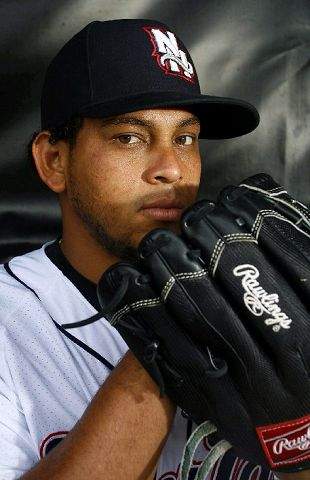
Henderson Alvarez' rising stock

During the 2009 season, Henderson Alvarez was widely considered to be the Blue Jays #1 pitching prospect, if not their #1 prospect overall. He featured a decent low 90's fastball as well as a good changeup, but as a lanky 19 year old in the low minors, it was difficult to make any kind of informed projection on the type of pitcher he could become.

At the season wore on, then General Manager J.P. Ricciardi made a substantial trade, sending Scott Rolen to the Cincinnati Reds at the trade deadline in exchange for Edwin Encarnacion and young pitchers Josh Roenicke and Zach Stewart. Stewart, the 22 year old flame throwing right hander (selected in the 3rd round of the 2008 draft) was the prize of the deal, and as such, media and bloggers across the nation turned their attention his way. To further compound Alvarez' prospect visibility issues, late 2009 was also the timeframe for the Roy Halladay situation. Excitment was spreading over which pitching prospects the Blue Jays may receive in exchange for the good doctor, and once again Alvarez was widely ignored.

At the end of the season, J.P. Ricciardi was replaced by new GM Alex Anthopolous, and on December 16th 2009 he made the transaction that may forever define his legacy: trading Roy Halladay to the Philadelphia Phillies for Kyle Drabek, Travis d'Arnaud, and Brett Wallace (via Oakland). Drabek had been the apple in the eye of most Blue Jays fans (and the management) as the Halladay rumors circulated, and with him now in the fold, Toronto had their new #1 prospect. During the winter leading up to the 2010 season, all of the major prospect outlets released their team-by-team rankings, and despite his outstanding 2009 season Alvarez was typically placed in the 6-10 range (8th for Baseball America, 9th for Baseball Prospectus).

His prospect status was damaged in 2009, but the 2010 season nearly destroyed it. Henderson Alvarez was promoted to Dunedin as a 20 year old, and the results were subpar given the expectations he created after a fine 2009 season with the Lansing Lugnuts. Outside of an increased groundball rate, Alvarez saw all of his important stats get worse: higher opponent batting average / walk rate / home run rate, lower strikeout rate. Despite this, Alvarez was named to the World squad of the 2010 MLB Futures game, an exhibition game for top prospects to showcase themselves during All Star weekend.

With a number of high picks due to free agency and an aggressive approach at the draft, Toronto saw an influx of new, high celing prospects enter the farm system in the summer of 2010. From Alvarez' perspective, this further diminished his prospect stock, as in the winter of 2010 he was ranked outside Baseball America's Top 10, and 16th on both Baseball Prospectus' list and my own personal rankings.

Despite his struggles with High-A Dunedin in 2010, the Blue Jays front office decided to challenge Alvarez in 2011 by sending him to New Hampshire (after a quick rehab stint with Dunedin in April). He met the challenge with an outstanding first half, and was once again named as the Blue Jays representative at the MLB Futures game during All Star weekend. His improvement from the 2010 season to now goes beyond statistics (to which the improvements are substantial), as what often gets forgotten when discussing Henderson Alvarez is his age. He is in the upper minors as a 21 year old, and is still maturing as a baseball player and growing into his body. Alvarez has always been known for an unbelievable changeup, but he has taken his fastball a step further this year. What was once a 90-92 mph fastball now sits 94-96 mph and, according to his New Hampshire pitching coach Pete Walker, has touched 101 mph in starts for the Fisher Cats this season.

With such a potent 1-2 punch, one might wonder why Alvarez does not have overpowering strikeout numbers. The reason is simple; Alvarez does not possess a strong enough breaking pitch. A strong fastball-changeup combination will destroy a hitter's timing if used properly, which will cause him to be early or late on his swing, depending upon the order in which they are thrown. This will cause a lot of weak contact, which explains both the variations in opposing batting average throughout his career, as well as a consistently strong ground ball percentage. Breaking pitches (such as a slider or curveball) are the prototypical swing and miss pitches, which results in a lot of strikeouts. This is because when executed properly, the ball will start within the strikezone, but as the batter begins to swing the ball moves out of strikezone and out of the hitter's swing plane.

Henderon Alvarez' primary breaking pitch is a slider, but it is very far behind his other two offerings. If the slider can continue to develop, even to just an average offering, Alvarez would have a ferocious arsenal and the long awaited gaudy strikeout numbers would arrive. What cannot be emphasized enough when discussing Alvarez is his age. To put it into perspective, if he were born in the United States he would be a college junior. College pitchers with two plus pitches and plus command usually go in the top 10 picks of the 1st round. Prospect folks, myself included, clearly lost sight of this over the past 2 seasons and passed judgement far too early. What Alvarez has done in 2011 is start to put it together, and to fully regain his prospect sparkle and receive the attention he deserves he must continue to do so. If his slider comes around, the sky will be the limit and Alvarez will be a force to be reckoned with -- and not only in the minor leagues, he's already knocking on the door in Toronto.

Images courtesy Mark Bolton (Union Leader) and John Lott (National Post).

Thursday, July 14, 2011

Midseason Report: Single-A Lansing


Team Record: 49-37 (1st in Eastern Division)
Number of team Top 15 prospects: 3 -- Marisnick, Perez, Hutchison

Similar to Dunedin, the Lansing Lugnuts have a strong roster overall despite having only 3 of the Blue Jays top 15 prospects. Top prospect or not, the offense is loaded with young players with potential, which has led to the Lugnuts being 2nd in the Midwest League in team OPS (.729). Additionally, all three Lansing outfielders made the All Star team as starters, with one playing designated hitter. The pitching has been less impressive, though they do still have a solid 3.92 team ERA, which ranks 11th in the league.

Notable hitters:

CF Jake Marisnick: .313/.380/.476 (.855 OPS), 18 2B, 4 3B, 7 HR, 55 RBI, 22 SB, 24/59 BB/K

Jake Marisnick has easily been the MVP of the Lugnuts squad thus far, and his above batting line is indicative why. Marisnick was named as a starter to the MWL All Star game, and has finally put up the numbers that his projectibility and tools suggest he's capable of. His performance has drawn the attention of most prospect aficionados, and will likely cause him to creep into Top 100 lists this coming winter.

LF Marcus Knecht: .311/.409/.507 (.917 OPS), 22 2B, 9 HR, 48 RBI, 41/72 BB/K

The Toronto native who was drafted in the 3rd round in 2010 has made a huge splash in his first full professional season. Like Marisnick, he was named to the MWL All Star team as the starter in left field due to his outstanding success at the plate (his .917 OPS is 3rd in the MWL). What has been most impressive about Knecht is his walk percentage, which is remarkable for a 20 year old.

RF Michael Crouse: .261/.344/.467 (.811 OPS). 20 2B, 5 3B, 9 HR, 47 RBI, 26 SB, 30/85 BB/K

The second Canadian in Lansing's outfield is the toolsy Michael Crouse. His style is a contrast to Knecht's, as Crouse takes an aggressive approach both at the plate and on the basepaths, and has a strong arm in right field. Also an All Star, Crouse was the Eastern Division's starting DH.

C Carlos Perez: .268/.324/.368 (.692 OPS), 12 2B, 4 3B, 2 HR, 26 RBI, 6 SB, 23/54 BB/K

Carlos Perez, Toronto's #8 prospect, has had a difficult season by his standards, though it is still decent for a catcher with such defensive prowess. While the dip in batting average isn't positive, the lack of power development and the decrease in his walk rate would have to be the two biggest disappointments of his season.

1B K.C. Hobson: .266/.371/.352 (.722 OPS), 14 2B, 3 HR, 37 RBI, 48/51 BB/K

The 20 year old Hobson has not shown the power you'd like to see out of a first base prospect, but his walk to strikeout ratio is too impressive to ignore. Hobson was drafted in the 6th round in 2009, and while it's doubtful he'll ever be a significant top 30 prospect in Toronto's system, he should be a useful piece in the organization.

Notable pitchers:

RHP Drew Hutchison: 72 IP, 68 H, 21 ER. 1 HR, 19 BB, 84 K, 2.63 ERA, 1.21 WHIP

The true ace of Lansing's staff, Hutchison recently earned a promotion to Dunedin to continue his development. However, while he was with the Lugnuts he dominated his opposition, highlighted by a 30+ consecutive scoreless inning streak, during which he made the leap to Dunedin. Hutchison was recently named to Keith Law's midseason Top 50 prospects, which speaks to just how successful and impressive Hutch has been this year.

RHP Casey Lawrence: 85.2 IP, 95 H, 36 ER, 7 HR, 17 BB, 68 K, 3.78 ERA, 1.31 WHIP

The 23 year old Lawrence was the opening day starter for Lansing this year, and he had a solid but unspectacular first half. Similar to K.C. Hobson, Lawrence is more of organizational depth than top 30 prospect material, as you would like to see more out of a 23 year old in A-ball. His biggest strength to the organization may be his ability to eat innings and lower the workload on some of the younger pitching prospects.

LHP Sean Nolin: 54 IP, 51 H, 24 ER, 5 HR, 15 BB, 55 K, 4.00 ERA, 1.22 WHIP

Drafted in the 6th round in 2010, Nolin is an imposing lefty standing at 6'5" and weighing 235 lbs. Nolin features three decent pitches -- a fastball, changeup, and curveball, and throws them will solid command. Despite not having any plus pitches (his changeup is his best pitch at above average), Nolin's ERA does not due justice to how well he has pitched, as he has strong hit, strikeout, walk, and home run numbers. Given his size it's unlikely he'll add to his fastball, so unless his secondary pitches improve dramatically he's likely organizational depth.

RHP Danny Barnes: 43.2 IP, 30 H, 14 ER, 2 HR, 12 BB, 68 K, 2.89 ERA, 0.96 WHIP

Barnes has flown under the radar since being drafted in the 35th round of the 2010 draft, but the Princeton product (yes, that Princeton) has done nothing but perform in his two years in the Blue Jays system. Barnes is a reliever with a 3/4 arm slot who throws a decent low 90's fastball as well as a changeup, curveball, and slider. After struggling against lefties in College and as a pro in 2010, his changeup has developed enough for Barnes to be used against both lefties and righties, which should improve his chances of reaching the majors.

Rest of the year outlook:

Lansing has already locked down a playoff spot, but exactly who will be on the roster when the playoffs roll around is another question. The starting rotation has already lost Drew Hutchison, and Casey Lawrence likely isn't far behind. Regardless, the strength of this Lugnuts roster has been the offense, and the fate of Lansing's three outfielders will likely determine the club's success in the playoffs. Despite all three being only 20 years old, they have proven they can handle Single-A ball and are ready for High-A. The question is whether or not they are late season promotions to Dunedin, or if they simply start there in 2012. I think it would be best for the three to stay and finish what they started with Lansing, and compete for the Midwest League championship. The three could then start 2012 in Dunedin and hopefully carry over their camaraderie and success.