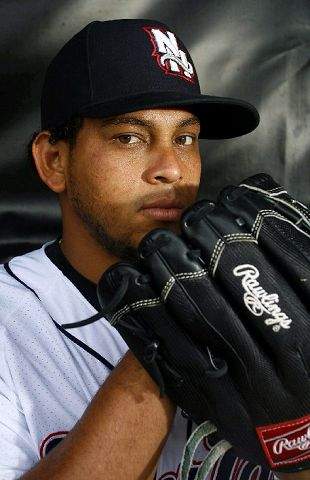
Showing posts with label Henderson Alvarez. Show all posts

Thursday, February 9, 2012

Blue Jay Prognostication: The Rotation


With Spring Training just around the corner, it’s time to look at what some of the major prognostication sources predict for Blue Jays players for the 2012 season. I gathered projections from four sources:

Bill James -– Author of “The Bill James Handbook” and one of the original sabermetricians
RotoChamp –- A fantasy baseball projection website
MLB.com –- The official fantasy baseball projections of Major League Baseball
PECOTA -– Baseball Prospectus’ weighted player projection system

In addition to those four projections, I added data from the 2011 season, as well as my personal prediction for each players statistics. With prognostication there’s no right or wrong way to do it -– trends, historical comparisons, three year averages, and league average systems are all valid. For my projections, I used a combination of statistical evidence and gut feeling, as one thing I have that the others do not is exposure. I watch 140+ games every season and immerse myself in everything Blue Jays. That has to count for something, right?

Ricky Romero


There’s no debating that 2011 was a breakout year for Ricky Romero. In his first year as the ace of the staff Romero encapsulated himself in the mantra, attacking hitters instead of nipping corners. As such, he threw a personal best 225 innings, while seeing both his walk rate and strikeout rate drop. That’s not to say Romero isn’t a strikeout pitcher anymore -– his 178 were 12th best in the AL –- he’s just pitching smarter. With runners on the corner and 1 out, it’s a lot easier to get out of the inning with a weak ground ball as opposed to two strikeouts.

With that being said, most projections seem to feel Romero is going to take a step back in 2012. His ERA is going to rise, there’s no doubt about that -– his .242 BABIP and 79.2% LOB values from last season are unsustainable. Even so, both Bill James and PECOTA went a bit overboard. The PECOTA projection of a 4.33 ERA and 1.40 WHIP is flabbergasting to anyone who actually watched a Blue Jays game last season. Assuming the strikeout and walk rates remain consistent with 2011 -– which all systems project them to –- the normalization of his BABIP and LOB% to more league average values would peg him with a low to mid 3 ERA and a WHIP in the low 1.2’s.

Brandon Morrow


For Morrow, 2011 was not the breakout season most Blue Jays fans were hoping for -– at least, not on the surface. Morrow’s ERA ballooned to 4.72, and even topped 5 in the summer months. Despite this, he did show some substantial signs of improvement. While adding 33 more innings onto his arm, Morrow maintained his league-leading strikeout rate, while cutting his walk rate from 4.06 to 3.46 – a significant improvement. The biggest problem for Morrow –- which has been well documented this offseason –- is his inability to get out of trouble once runners get aboard. His 65.5% LOB rate is well below league average, and absolutely killed his ERA.

All five prognostications, myself included, agree that Morrow should finally turn the corner in 2012. The amount in which he’ll improve, however, is up for debate. MLB.com and PECOTA have the most pessimistic projections, expecting a drop-off in strikeout rate with an increase in walk rate. I disagree, and have the most optimistic view of Morrow’s 2012 season. While I expect the strikeout rate to take a small step back as Morrow further approaches the 200 inning plateau, I feel the biggest difference this season will be improved command. Morrow has substantially improved his walk rate in each of the past three seasons, and with his newfound aggressive mentality, I expect him to attack hitters in 2012 and further cut down that walk rate.

Henderson Alvarez


Alvarez will only be 21 years old on Opening Day, yet after an impressive top-to-bottom 2011 season, there’s little doubt he is poised to make the leap to full-time MLB starter. After receiving the call in August, Alvarez displayed his power arsenal and impeccable command, dominating hitters to the tune of a 3.53 ERA and 1.13 WHIP. What was perhaps even more impressive was his stamina and reliability, as he pitched 6 or more innings in eight of his ten starts. The only flaw with his debut was the lack of strikeouts, as Alvarez’ 5.65 K/9 were subpar for a pitcher with his type of stuff.

Bill James failed to give a projection for Hendo, so in the case of Alvarez we have only four predictions to inspect. It’s readily apparent that one of the four is not like the others. PECOTA expects a complete implosion by Alvarez, pegging him for a 5.50 ERA, 1.51 WHIP, and an unfathomable 4.40 K/9. Additionally, they project a walk rate approaching 3, despite the fact Hendo’s worst walk rate at any level is 2.16. To be perfectly frank, that prediction deserves to be thrown out. The remaining three projections all agree that Alvarez’ ERA is likely to fall in the mid-3 range. RotoChamp expects him to maintain his impeccable 2011 command, walking only 19 in 150 innings while striking out a modest 95. MLB.com and I, however, feel he’ll throttle up the strikeouts at the expense of some command. Throughout his minor league career, Alvarez was typically in the mid to high 6 range for strikeouts per 9, and with his stuff, there’s no reason that shouldn’t translate to the major leagues in 2012.

Brett Cecil


After being selected by Toronto in the 1st round of the 2007 draft, Brett Cecil really appeared to come into his own in 2010. While the ERA was merely “good” at 4.22, he showed excellent command, strong groundball tendencies, and a solid strikeout rate. He even led the team in wins, with 15. Things fell apart quickly in 2011, as after an ugly start to the season he faced a demotion to Triple-A, where he would make 12 starts. Even after his return in late June he still wasn’t the same pitcher we saw in 2010. The strikeouts were still there, but the groundout to flyout ratio of 0.81 was well below the 1.21 mark from 2010 that allowed him to be so successful.

If a lack of conditioning is the reason for the drop in performance, then the problem should be easily remedied. All five prognostications –- myself included -– expect an improvement in 2012, though the degree of improvement is quite varied. MLB.com projects drastic improvements in both strikeout and walk rates, resulting in what would be a career-best ERA of 3.82. The remaining four expect Cecil to post rates consistent with his 2010 and 2011 numbers, but an improved ERA due to a more Brett Cecil-like groundball rate. Throughout his minor league career his groundout to flyout ratio was around 2, and with a focus on conditioning and fundamentals there’s no reason his ratio should be as poor as it was last season.

Dustin McGowan


The fact McGowan is even mentioned on the starting pitcher projections is incredible given what he’s gone through since 2008. A trio of major surgeries and seemingly endless rehabilitation kept McGowan out of the major leagues for over three calendar years before he finally returned late last season. The Blue Jays have been medically advised that McGowan has a better chance of remaining healthy with a consistent schedule, and Toronto appears poised to give him every opportunity to achieve that consistency as a member of the rotation in 2012.

Given the lack of any actual data for three years, it’s astounding how similar all five projections are. The range in innings, strikeouts, and walks are 15, 19, and 16 respectively, while the range in ERA is merely a third of a run. The biggest variance is hits allowed (and therefore WHIP), but given that only 3 of the lines have projections for those statistics it’s hard to make any substantial analysis. PECOTA and MLB.com estimate roughly a hit per inning, but when considering how in his last healthy season (2007) he held hitters to a .230 batting average against -– and his stuff is still there -– I find that hard to believe. Regardless, Dustin McGowan is in such a bizarre and unique situation that absolutely anything could happen.

Kyle Drabek


How the mighty have fallen. Drabek was pegged as one of the favorites for the American League Rookie of the Year in the spring of 2011, and his first start of the year –- 7 one-hit innings –- only further cemented that optimism. As the season wore on, Drabek’s control and curveball left him, followed closely by his confidence. He became a shell of his former self, and only got worse after an ill-advised demotion to the launching pad of Las Vegas. A year after being Toronto’s best pitching prospect, Drabek is now the red-headed step child to this often unforgiving fanbase.

I easily have the most optimistic projection for Drabek, and it’s because he’s simply too young and talented to give up on. A year ago, a 4.40 ERA and 1.42 would be a pessimistic view on Drabek. Today, fans would shed tears of joy if he achieved those goals. He has a power fastball, incredible curveball (which completely disappeared in his disastrous 2011 -– coincidence?), and a much improved cutter. His command is without a doubt shaky, but he has the stuff and the pedigree to be a successful major league pitcher. For now, Drabek just needs to focus on the basics that made him the heralded prospect he was and take things one step at a time. The numbers will come later. I’m not even going to discuss the negative predictions -- if you want to see someone kick a guy while he's down, look elsewhere. Blue Jays fans need to remember that every time Drabek blew a game, it hurt him far more than it hurt us. He deserves a chance at redemption.

Monday, October 3, 2011

Making the Grade: The Starters


The first segment of "Making the Grade" will be Toronto's starting pitchers. While we saw a large number of different pitchers make starts throughout the year, this list will be exclusively for pitchers who either finished the season in the starting rotation, or made more starts than relief appearances throughout the duration of the season.

Part II Making the Grade: The Bullpen
Part III Making the Grade: The Infield
Part IV Making the Grade: The Outfield

LHP Ricky Romero (26)
15-11, 225 IP, 176 H, 73 ER, 26 HR, 80 BB, 178 K
2.92 ERA, 1.14 WHIP, 2.23 K/BB, 7.12 K/9, 1.79 GO/AO

For the second consecutive offseason, Toronto traded their previous years' Opening Day starter, which forced Romero directly into the spotlight as the new ace of the staff. Ricky stepped up to the challenge being laid down, posting careers bests in innings pitched, ERA, and walks per nine. Romero fully embraced the ace mantra, as he sacrificed strikeouts in an effort to go deeper into ball games (2010: 15.3 pitches per inning, 2011: 14.9 pitches per innning). In addition to throwing more 2-seam fastballs, Romero also threw harder than ever before, with his fastball averaging 92.0 mph in 2011 after averaging 90.9 mph in 2010. The only thing holding him back from an A+ grade are home runs allowed, where Romero's 26 were tied for 4th in the AL.

Grade: A

RHP Brandon Morrow (27)
11-11, 179.1 IP, 162 H, 94 ER, 21 HR, 69 BB, 203 K
4.72 ERA, 1.29 WHIP, 2.94 K/BB, 10.19 K/9, 0.71 GO/AO

To say that expectation were high for Brandon Morrow entering 2011 would be a colossal understatement. After putting together a 3.69 ERA and 1.21 WHIP in the second half of 2010, it was thought Morrow was ready to take the next step into ace-dome and help Ricky Romero lead this pitching staff into the future. While Romero took the step forward, Morrow stumbled out of the starting block (5.51 ERA, 1.56 WHIP in May after making only 2 April starts) and was never able to fully recover. The three positives to come from Morrow's season were his health, the development of a cutter late in the season as well as an improvement in command (2010: 4.06 BB/9, 2011: 3.46 BB/9), which kept him from a failing grade.

Grade: C

LHP Brett Cecil (25)
4-11, 123.2 IP, 122 H, 65 ER, 22 HR, 42 BB, 87 K
4.73 ERA, 1.33 WHIP, 2.07 K/BB, 6.33 K/9, 0.81 GO/AO

While the W/L record and ERA look bad, Cecil's 2011 season wasn't that different than his breakout 2010 season. His strikeout rate improved, while his walk and groundball rates declined slightly. The biggest difference was a spiked home run rate (2010: 8.7% HR/FB, 2011: 13.3% HR/FB), which was likely the result of a decline in average fastball velocity (2010: 90.1 mph, 2011: 88.5 mph). Cecil has put on 10-15 lbs since being drafted, so it is possible the dip in velocity is related to a lack of conditioning on Cecil's part. Cecil did not do enough in 2011 to guarantee a rotation spot entering next season, so hopefully he will take offseason workouts more seriously this time around.

Grade: C-

RHP Henderson Alvarez (21)
1-3, 63.2 IP, 64 H, 25 ER, 8 HR, 8 BB, 40 K
3.53 ERA, 1.13 WHIP, 5.00 K/BB, 5.65 K/9, 1.75 GO/AO

Henderson Alvarez has almost everything you want in a pitching prospect. Despite being plucked from the minor leagues at the ripe age of 21, he showed no fear in facing major league hitters, carving up lineups with command (1.13 BB/9) that hasn't been seen in Toronto since Roy Halladay left town. Alvarez works primarily off his heavy 92-95 mph fastball (averaged 93.3 mph), throwing it 71.8% of the time. His changeup came as advertised, while his slider looked surprisingly good given how sparingly he throws it. His one victory in ten starts should ashame the Blue Jays offense, as Hendo was the 2nd best pitcher on the team over the last two months of the season. The only issue with Hendo is the lack of strikeouts, as pitchers with stuff like him should not have a sub-6 K/9.

Grade: A-

RHP Dustin McGowan (29)
0-2, 21 IP, 20 H, 15 ER, 4 HR, 13 BB, 20 K
6.43 ERA, 1.57 WHIP, 1.54 K/BB, 8.57 K/9, 1.47 GO/AO

The fact that McGowan has returned to the big leagues at all is a victory in and of itself, and as such expectations should be grounded. After missing nearly three full seasons due to a variety of injuries, McGowan managed to pitch quite well in his return. The walk rate was high, but given that command is always the last thing to return after coming back from serious arm injuries, it's unsurprising. The biggest positive for McGowan was that he maintained his strong repetoire despite the layoff. His fastball averaged 93.0 mph, and his power slider clocked in with an 86.9 mph average.

Grade: B+

RHP Kyle Drabek (23)
4-5, 78.2 IP, 87 H, 53 ER, 10 HR, 55 BB, 51 K
6.06 ERA, 1.81 WHIP, 0.93 K/BB, 5.83 K/9, 1.22 GO/AO

It's extremely difficult to say anything positive about Kyle Drabek's season. Plain and simply, he shit the bed. At the time of his demotion he led all of baseball in walks, and was one of the few pitchers with fewer strikeouts than walks. In addition to losing any semblance of command, he got hit around, and his .310 BABIP suggests hitters weren't getting lucky -- they were driving balls. Drbaek was demoted to Triple-A in June and actually pitched worse in the minor leagues. Experts are flabbergasted at Drabek's implosion, and it can only be hoped that four months away from pitching and a clean slate to start 2012 will be the cure to what ails him.

Grade: F

Saturday, July 16, 2011

Henderson Alvarez' rising stock

During the 2009 season, Henderson Alvarez was widely considered to be the Blue Jays #1 pitching prospect, if not their #1 prospect overall. He featured a decent low 90's fastball as well as a good changeup, but as a lanky 19 year old in the low minors, it was difficult to make any kind of informed projection on the type of pitcher he could become.

At the season wore on, then General Manager J.P. Ricciardi made a substantial trade, sending Scott Rolen to the Cincinnati Reds at the trade deadline in exchange for Edwin Encarnacion and young pitchers Josh Roenicke and Zach Stewart. Stewart, the 22 year old flame throwing right hander (selected in the 3rd round of the 2008 draft) was the prize of the deal, and as such, media and bloggers across the nation turned their attention his way. To further compound Alvarez' prospect visibility issues, late 2009 was also the timeframe for the Roy Halladay situation. Excitment was spreading over which pitching prospects the Blue Jays may receive in exchange for the good doctor, and once again Alvarez was widely ignored.

At the end of the season, J.P. Ricciardi was replaced by new GM Alex Anthopolous, and on December 16th 2009 he made the transaction that may forever define his legacy: trading Roy Halladay to the Philadelphia Phillies for Kyle Drabek, Travis d'Arnaud, and Brett Wallace (via Oakland). Drabek had been the apple in the eye of most Blue Jays fans (and the management) as the Halladay rumors circulated, and with him now in the fold, Toronto had their new #1 prospect. During the winter leading up to the 2010 season, all of the major prospect outlets released their team-by-team rankings, and despite his outstanding 2009 season Alvarez was typically placed in the 6-10 range (8th for Baseball America, 9th for Baseball Prospectus).

His prospect status was damaged in 2009, but the 2010 season nearly destroyed it. Henderson Alvarez was promoted to Dunedin as a 20 year old, and the results were subpar given the expectations he created after a fine 2009 season with the Lansing Lugnuts. Outside of an increased groundball rate, Alvarez saw all of his important stats get worse: higher opponent batting average / walk rate / home run rate, lower strikeout rate. Despite this, Alvarez was named to the World squad of the 2010 MLB Futures game, an exhibition game for top prospects to showcase themselves during All Star weekend.

With a number of high picks due to free agency and an aggressive approach at the draft, Toronto saw an influx of new, high celing prospects enter the farm system in the summer of 2010. From Alvarez' perspective, this further diminished his prospect stock, as in the winter of 2010 he was ranked outside Baseball America's Top 10, and 16th on both Baseball Prospectus' list and my own personal rankings.

Despite his struggles with High-A Dunedin in 2010, the Blue Jays front office decided to challenge Alvarez in 2011 by sending him to New Hampshire (after a quick rehab stint with Dunedin in April). He met the challenge with an outstanding first half, and was once again named as the Blue Jays representative at the MLB Futures game during All Star weekend. His improvement from the 2010 season to now goes beyond statistics (to which the improvements are substantial), as what often gets forgotten when discussing Henderson Alvarez is his age. He is in the upper minors as a 21 year old, and is still maturing as a baseball player and growing into his body. Alvarez has always been known for an unbelievable changeup, but he has taken his fastball a step further this year. What was once a 90-92 mph fastball now sits 94-96 mph and, according to his New Hampshire pitching coach Pete Walker, has touched 101 mph in starts for the Fisher Cats this season.

With such a potent 1-2 punch, one might wonder why Alvarez does not have overpowering strikeout numbers. The reason is simple; Alvarez does not possess a strong enough breaking pitch. A strong fastball-changeup combination will destroy a hitter's timing if used properly, which will cause him to be early or late on his swing, depending upon the order in which they are thrown. This will cause a lot of weak contact, which explains both the variations in opposing batting average throughout his career, as well as a consistently strong ground ball percentage. Breaking pitches (such as a slider or curveball) are the prototypical swing and miss pitches, which results in a lot of strikeouts. This is because when executed properly, the ball will start within the strikezone, but as the batter begins to swing the ball moves out of strikezone and out of the hitter's swing plane.

Henderon Alvarez' primary breaking pitch is a slider, but it is very far behind his other two offerings. If the slider can continue to develop, even to just an average offering, Alvarez would have a ferocious arsenal and the long awaited gaudy strikeout numbers would arrive. What cannot be emphasized enough when discussing Alvarez is his age. To put it into perspective, if he were born in the United States he would be a college junior. College pitchers with two plus pitches and plus command usually go in the top 10 picks of the 1st round. Prospect folks, myself included, clearly lost sight of this over the past 2 seasons and passed judgement far too early. What Alvarez has done in 2011 is start to put it together, and to fully regain his prospect sparkle and receive the attention he deserves he must continue to do so. If his slider comes around, the sky will be the limit and Alvarez will be a force to be reckoned with -- and not only in the minor leagues, he's already knocking on the door in Toronto.

Images courtesy Mark Bolton (Union Leader) and John Lott (National Post).