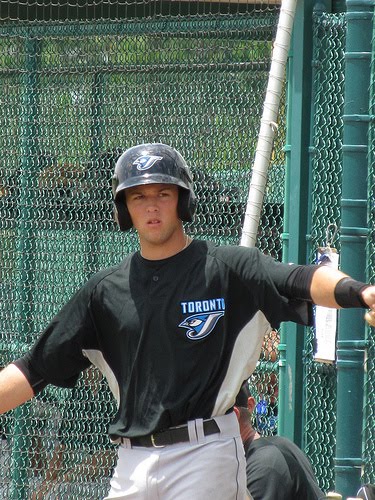
Showing posts with label Adeiny Hechavarria. Show all posts

Friday, February 10, 2012

2012 Top Prospects #16: Adeiny Hechavarria

Name: Adeiny Hechavarria
Position: Shortstop
Acquired: Signed as free agent in April 2010
Opening Day age: 22
Height/weight: 5’11”/180 lbs
Best/worst tool: Fielding/bat
Risk factor: Low
ETA: 2012

Scouting Report

Hechavarria is the prototypical all-glove no-bat shortstop. His defensive skills -– the best in Toronto’s system, and some of the best in all of minor league baseball -– have lived up to the hype that earned him a 10-million dollar Major League deal that included a Toronto-record 4-million dollar signing bonus. He has above average athleticism, a quick first step, and incredible instincts, giving him a ridiculous range at shortstop. Not only can he get to the ball, but his soft hands ensure he rarely misplays it -– a true plus-plus defender. His arm is fringe-plus, so there is no concern he’ll ever need to move to second base. Hechavarria has raised the arm slot on his throws, as he too often threw sidearm, giving him almost two-seam fastball action and causing difficulties for his other infielders. As previously mentioned, he has above average athleticism and speed, but his baserunning skills leave a lot to be desired. The potential is there for 20+ stolen bases, but unless he improves in that regard he may rarely be given the green light. His power is fringe-average, but it plays well as a shortstop. Over a full season he could rack up 10-12 home runs with plenty of doubles and triples. At the plate, Hechavarria has an open stance and quick hands. He gets the bat through the zone with a level swing but is overly aggressive, giving him below average contact skills. He was tried as a leadoff hitter in an effort to increase his at-bats, but the discipline simply isn’t there for it to be a permanent role. Hechavarria is still young and could improve in that regard, but it seems likely he’s ticketed for the bottom of the lineup.

2011 Statistics and Analysis

(AA) 464 AB, .235/.275/.347 (.622 OPS), 22 2B, 6 3B, 6 HR, 46 RBI, 19 SB, 25/78 BB/K

(AAA) 108 AB, .389/.431/.537 (.968 OPS), 6 2B, 2 3B, 2 HR, 11 RBI, 1 SB, 8/21 BB/K

In his second professional season stateside, Hechavarria began where he left off in 2010 – Double-A. Despite repeating the level, his 2011 numbers (.622 OPS) were actually significantly worse than his 2010 numbers (.665 OPS). Hechavarria was expected to have a rough bat, but his lack of significant development over two full seasons is concerning. His power and plate approach have improved – his ISO and BB% have gone from dreadful to acceptable (for a middle infielder) – but the contact skills are still lacking. After yet another undeserved promotion, Hechavarria actually performed admirably over the final month of the season with Triple-A Las Vegas. Whether the results were 51’s hitting coach Chad Mottola unlocked something in his swing or a case of small sample size and park factors is up for debate, but his .471 BABIP in Triple-A suggests it’s probably the latter.

Expected 2012 Assignment: Triple-A Las Vegas

Future Outlook

His glove alone will get him to the Major Leagues, likely at some point this season. Yunel Escobar is the better player and has shortstop locked down for the next 2-4 years, so a possible starting role in the near future isn’t clear. Hechavarria is more than good enough defensively to play second base, but his bat simply isn’t good enough to make that a worthwhile move in the long run. Toronto has no other middle infield prospects ready to break into the show, so Hechavarria has some time to figure things out offensively without being leapfrogged on the depth chart. For now though, he is ticketed for a return to Triple-A Las Vegas, and will await an injury to the infield.

Perfect World Projection: Everyday shortstop who hits 8th or 9th in the lineup and regularly contends for Gold Glove awards.

Tuesday, November 29, 2011

Blue Jays Positional Primer: Middle Infield

Inspiration for the Blue Jays Positional Primer series comes from Jason Parks of Baseball Prospectus. Over the course of the second half of the season, Jason examined the prospects in the entire minor leagues on a position-by-position basis, giving insight into players both within and well outside the top 100 rankings.

While the sample size of one team is vastly inferior to that of the entire minor leagues, I feel Toronto has enough depth in the farm -- particularly in the low minors -- that such a series could provide some insight into prospects that Blue Jays fans aren't as familiar with as they should be. This is the third installment of an eight part series that will examine catcher, first base, middle infield, third base, center field, corner outfield, right handed pitcher, and left handed pitcher. The middle infield and corner outfield lists are included as there's really no such thing as a second base or left field prospect, they're just shortstops and center/right fielders who couldn't handle the defensive demands and get moved to the easier defensive position as they age. It should be noted that -- outside of the Leader of the Pack, who is the #1 for the position -- these are not necessarily progressive rankings of the prospects

Part I -- Blue Jays Positional Primer: Catcher
Part II -- Blue Jays Positional Primer: First Base
Part IV -- Blue Jays Positional Primer: Third Base
Part V -- Blue Jays Positional Primer: Center Field
Part VI -- Blue Jays Positional Primer: Corner Outfield
Part VII -- Blue Jays Positional Primer: Right-handed Pitcher
Part VIII -- Blue Jays Positional Primer: Left-handed Pitcher

The Leader of the Pack

Adeiny Hechavarria –- 2011 team(s): Double-A New Hampshire, Triple-A Las Vegas
572 AB, .264/.305/.383 (.687 OPS), 28 2B, 8 3B, 8 HR, 57 RBI, 20 SB, 33/99 BB/K

Powered by one of the best gloves in the minor leagues, Adeiny Hechavarria takes the crown as the Leader of the Pack in the middle infield division. Hechavarria was signed in April of the 2010 season to a 4 year, 10 million dollar major league contract. He started the year working in extended spring training, getting acclimated to the American culture in a low stress environment. He began his official playing career with the High-A Dunedin affiliate, who play out of the Blue Jays spring training complex.

Hechavarria proved to be extremely raw, hitting .193/.217/.292 (.509) in a little over a month’s worth of games with the D-Jays while being perhaps too flashy in the field. Much to the shock of the fanbase, Hechavarria was promoted to New Hampshire in the summer, where, with the help of Spanish-speaking manager Luis Rivera, he managed to turn his season around, hitting a respectable .273/.305/.360 (.665). The fielding became more fundamentally sound as the season wore on, as his throws straightened out after previously throwing sidearm-with-tail across the diamond. The 5’11” shortstop frequently displayed his athleticism, but is still raw in terms of base running, as he will on occasion kill rallies running into outs. His power is average for a middle infielder, as he should be capable of hitting 10+ home runs with plenty of doubles and triples as he finishes maturing physically. The only drawback with Hechavarria is his bat tool, which is currently below average with only average potential, at best.

His second year, 2011, was the tale of two seasons. He spent the first four-plus months with Double-A New Hampshire, hitting .235/.275/.347 (.622) in 111 games. Much like 2010, Hechavarria received yet another seemingly undeserved promotion, and once again, he turned his game up afterwards. Hechavarria hit .389/.431/.537 (.968) in 25 games with the 51’s, and Las Vegas hitting coach Chad Mottola feels he can turn Adeiny’s bat around with some extended work. Hechavarria should have plenty of time to work with Mottola, as it’s expected that he’ll be assigned to Triple-A out of spring training next season, barring an unforeseen lack of moves this offseason. If he can get things together on the offensive side of the game, Hechavarria has a chance to be a very good player.

The Question Mark

Gustavo Pierre -– 2011 team(s): Rookie-Class Bluefield, Single-A Lansing
437 AB, .224/.290/.339 (.629 OPS), 16 2B, 5 3B, 8 HR, 41 RBI, 15 SB, 39/125 BB/K

Gustavo Pierre fall into the Question Mark category, as he may have the widest range of projections of anyone in the farm system. It’s debatable whether Pierre even belongs on the middle infield list, as at 19 years old and already 6’2” (with some growth left), he may be moved to a corner (infield, or outfield) sooner rather than later. Born in the Dominican, Pierre was acquired through International Free Agency in 2008, receiving a signing bonus of 0.7M.

Despite signing prior to the start of the short season leagues in 2008, Pierre didn’t make his professional debut until the 2009 season. He underwent Tommy John surgery in his signing year, which could partially attribute to the fielding issues that are glaring in his statistical lines. In his 233 career minor league games, he has committed 87 fielding errors. While errors are far from the best indicators of a defender’s abilities, where there’s smoke there’s often fire. It’s impossible to accurately evaluate Pierre’s fielding abilities without seeing him in person, but it’s possible the Tommy John surgery affected his arm in a way that makes his throws inaccurate. If this were the case, it would likely rule out third base as an eventual destination, perhaps making left field –- a position where throws are less important but he could still display his athleticism -– a more viable option.

Aside from his defensive flaws, Pierre is very athletic and has the potential for above average to plus power. Scouts rave over the way the ball comes off his bat, but making consistent contact has been an issue for him. A simple case of poor mechanics would be outstanding news, as it’s far easier to teach stances and timing than it is pure bat speed. Pierre started the season with Single-A Lansing but it became readily apparent he wasn’t yet ready for full-season ball, as he hit only .187/.244/.262 (.506) in 56 games. He was much better after his demotion to Rookie-Class Bluefield, hitting .252/.324/.396 (.720) in 63 games, showing impressive power (12 doubles, 3 triples, 6 home runs) and greatly improved plate discipline (26 walks) while facing pitchers more in line with his age and experience. With no shortstops immediately ahead of him on the depth chart, Pierre should get another shot with Lansing out of the spring, where he can once again attempt to erase some of the question marks tainting his prospect status.

Remember the Name(s)

Dickie Joe Thon -– 2011 team: GCL Blue Jays
121 AB, .223/.369/.322 (.691 OPS), 3 2B, 0 3B, 3 HR, 15 RBI, 6 SB, 23/44 BB/K

Dickie Thon is the perfect example of how the round a player is drafted in is not indicative of their talent level. A 5th round pick in 2010, Thon signed for a well over slot bonus of 1.5M. Negotiations were pulled into the public eye, as it was rumored that Thon’s father (of the same name) was hoping to see his son play for his former team, the Houston Astros. Despite this hiccup, Thon signed prior to the deadline, but was not assigned to any minor league affiliates, instead making his debut in 2011.

While the numbers for his professional debut aren’t particularly strong, scouts who had the opportunity to watch him play raved about his tools. Thon has the most offensive potential of any player on this list. He generates good bat speed, but has struggled with consistency. As a 19 year old playing with wooden bats for the first time, that’s both understandable and expected. Thon displays strong gap power, but as he continues to mature and fill out his athletic 6’2” frame, those gappers could start finding their way out of the park. He shows an impressive plate approach for such a young player, walking 23 times in 45 games. Thon’s best tool is his athletic ability, a trait that was passed down from his father (Thon Sr averaged 5 triples and 20 stolen bases per season across his 15 year major league career, peaking at 10 and 37 respectively). His arm and fielding tools are more fundamental than flash, but he has the athleticism and work ethic for both to develop into plus tools. Thon is the total package, with the potential for five above average tools.

Jorge Vega-Rosado –- 2011 team: GCL Blue Jays
183 AB, .317/.380/.470 (.850 OPS), 12 2B, 2 3B, 4 HR, 30 RBI, 22 SB, 19/40 BB/K

With all of the youth at the shortstop position in the Blue Jays system, the middle infield category has two players in the Remember the Name category. The second, JVR, was a 28th round pick in the 2011 draft. He signed in mid-June for approximately slot money, allowing him to make his debut during his draft year –- and what a debut it was. Rosado was one of best hitter on the Gulf Coast Blue Jays, ranking 3rd in batting average, 5th in OBP, 4th in SLG, 4th in OPS, 1st in doubles, 3rd in triples, 3rd in home runs, and 1st in stolen bases )among players with 50 or more at-bats). Given the demands of his defensive position, these were outstanding numbers.

The previous three shortstops on this list all have long, athletic frames with room to grow. JVR does not fall into the same category. A week away from his 20th birthday, Rosado stands only 5’8”, weighing 175 lbs. He is not a player who is going to develop significant power down the road, though as a middle infielder power is a bonus, not a requirement. His bat was impressive in his debut, but it will be tested as the Puerto Rican starts facing more experienced competition next year with Bluefield or Vancouver. JVR committed 11 errors in 51 games at shortstop, but as I mentioned with Gustavo Pierre, errors are a poor statistical measure of defense without additional evidence. As a 28th round pick playing in the Gulf Coast League, Rosado’s public exposure was limited. Hopefully another year of success at a more significant minor league level will force scouts and prospect experts to talk about him often.

Sunday, November 13, 2011

AFL Update: November 13th


Over a month into the AFL season, it's time to take a look at how Toronto's farmhands have performed down with the Phoenix Desert Dogs

CF Anthony Gose (21, 2011 team: Double-A New Hampshire)
.255/.359/.455 (.814 OPS), 5 2B, 4 3B, 3 HR, 19 RBI, 7 SB, 13/37 BB/K

Twenty-seven games into his AFL career, Anthony Gose is putting together a batting line quite reminiscent to that of his 2011 regular season (.253/.349/.415). The most significant difference is the slugging, which shouldn't come as much of a surprise given the hitter-friendly (or rather, pitching-poor) AFL environment. He's still striking out far too much (37 K's in 27 games after 154 K's in 137 Double-A games), but the power is really coming together. A year ago, Anthony Gose posting a .200 ISO would seem like a laughable proposal -- but he's done exactly that with the Desert Dogs.

SS Adeiny Hechavarria (22, 2011 team: Double-A New Hampshire)
.250/.308/.444 (.752 OPS), 3 2B, 4 3B, 1 HR, 8 RBI, 1 SB, 6/17 BB/K

As mentioned a few days ago, Adeiny Hechavarria is having a decent AFL season thus far, but it's not enough to shake my fear that he might never become an average offensive shortstop. There's decent power potential here, and more importantly he's showing some improved plate discipline. Adeiny's biggest issue is making consistent, solid contact, a problem he's clearly struggling with in the AFL as well.

3B Kevin Ahrens (22, 2011 team: High-A Dunedin)
.259/.330/.395 (.725 OPS), 8 2B, 0 3B, 1 HR, 12 RBI, 1 SB, 9/22 BB/K

Like Anthony Gose, Kevin Ahrens is hitting at nearly an identical clip to that of his regular season (.725 OPS with Phoenix, .723 OPS with Dunedin). In Ahrens' case, this is quite promising. Ahrens spent the entire season in High-A, and with the Desert Dogs, he is facing veteran pitchers who hail from as high up as Triple-A. Over the last few seasons he has shown consistently improving power and plate discipline, but his bat skills have failed to show any significant improvement. Hopefully the AFL experience will better prepare him for a Double-A assignment next season.

C Yan Gomes (24, 2011 team: Double-A New Hampshire)
.229/.351/.271 (.622 OPS), 2 2B, 0 3B, 0 HR, 3 RBI, 0 SB, 7/15 BB/K

Yan Gomes has decent power and receiving tools, but he has never shown enough to be considered a true prospect, particularly in a catching-rich system like Toronto's (Arencibia, d'Arnaud, Jimenez, Perez, etc). The Desert Dogs have used a revolving door at catcher, with Gomes splitting time with Roberto Perez (CLE) and Ryan Ortiz (OAK). As such, he's seen only 48 at-bats.

RHP Chad Beck (26, 2011 teams: Double-A New Hampshire, Triple-A Las Vegas)
8 IP, 2 H, 0 ER, 0 HR, 1 BB, 5 K, 0.00 ERA, 0.38 WHIP, 0.73 GO/AO

Chad Beck started the AFL season with Phoenix, but has since been shut down, likely due to a Toronto-enforced innings limit (142 MiLB IP, 2.1 MLB IP, 8 AFL IP = 152.1 IP). While he was with the Desert Dogs, however, he was absolute dynamite, allowing only 3 base runners in eight innings of work. The AFL was likely a final test for Beck as he readies himself for a bullpen role in the major leagues next year.

LHP Evan Crawford (25, 2011 team: Double-A New Hampshire)
15.2 IP, 13 H, 6 ER, 0 HR, 3 BB, 14 K, 3.45 ERA, 1.02 WHIP, 2.56 GO/AO

The left handed Crawford is coming off consecutive strong seasons in the Blue Jays minor leagues, both of which have come since he made the conversion to relief pitching. He has carried over that success to the AFL, showing strong command and groundball tendencies while maintaining an outstanding strikeout rate. He's no top prospect, but he does have big league potential, perhaps as soon as next season.

RHP Wes Etheridge (27, 2011 team: High-A Dunedin)
6.2 IP, 7 H, 2 ER, 0 HR, 4 BB, 3 K, 2.70 ERA, 1.65 WHIP, 1.50 GO/AO

After setting a Dunedin saves record with 32, Wes Etheridge has struggled to continue the success he experienced in High-A with the Desert Dogs. In Dunedin, Etheridge owned the strikezone, putting together a 38/7 strikeout to walk ratio across his 47.2 innings. With Phoenix, he has already walked 4 batters in his 6.2 innings, creating an ugly WHIP despite a sharp looking ERA.

LHP Aaron Loup (23, 2011 team: High-A Dunedin)
15.1 IP, 14 H, 8 ER, 1 HR, 1 BB, 16 K, 4.70 ERA, 0.98 WHIP, 1.31 GO/AO

Almost like a mirror opposite of Etheridge, Aaron Loup has put together fantastic secondary statistics while producing a mediocre ERA. His strikezone control has been impeccable, with a 16/1 strikeout to walk ratio, and despite seemingly living in and around the strikezone, he is still allowing less than a hit per inning. The 2009 draftee isn't much of a prospect, but he is likely garnering the attention of the front office with this performance, and may earn himself an upper minors assignment.

Wednesday, November 9, 2011

What exactly is Adeiny Hechavarria?

With the winter approaching and prospects lists slowly beginning to leak their way onto the internet, I have caught myself more than a few times thinking about the Blue Jays farm system in preparation for my own top prospect list in the new year.

In order to come up with my rankings, I make a series of lists throughout the winter, each without looking at any of my previous versions. I find this to be the best way to digest and analyze new information and thoughts I might have acquired without being heavily influenced by earlier judgements. When I eventually make my final rankings, I can look at the consistencies, inconsistencies, and trends my lists may have shown over the winter and use that information to give me a fair and unbiased review of the farm.

Only a few lists into this process, I can already sense there is at least one player that I really don't have a firm grasp on -- Cuban shortstop Adeiny Hechavarria. Entering the 2011 season, I had ranked Hechavarria as the #12 prospect in the Blue Jays system, while describing how his bat was the biggest question mark in determining how much success he would have. A season later, the same huge, elephant-in-the-room questions remain.

Will Hechavarria ever hit? How do you rank an all-defense prospect?

These are the two questions I keep asking myself when attempting to rank Hechavarria. The latter question would be easy to answer if I had confidence in the former. If I felt like it was only a matter of time before Hechavarria started putting together some solid offensive seasons, it would be easy to rank him in the top 10 -- perhaps even higher -- as shortstops with a potential all around tools package like that don't come around often. The problem is, two seasons into his career, Hechavarria has damaged most hope I had of him becoming a plus offensive shortstop.

In his debut season, Hechavarria hit .242/.272/.333 (.605) between Dunedin and New Hampshire. The following year, 2011, he hit .264/.305/.383 (.687) between New Hampshire and Las Vegas. While the Las Vegas portion of his slash line (.389/.431/.537) certainly looks good, it was only a months worth of at-bats, and the Pacific Coast League isn't exactly known for its pitchers. After the MiLB season came to an end, it was announced that Hechavarria would be assigned to the Phoenix Desert Dogs of the Arizona Fall League to continue his development. He has put together a solid, albeit unspectacular line of .246/.300/.462 (.762), as of November 9th. Much like the Pacific Coast League, however, the AFL is a notorious hitters league, so the power numbers (particularly the 4 triples in 17 games) should taken with a grain of salt.

I'm finding it harder and harder to convince myself that Hechavarria will ever be anything more than a .270/.320/.380 hitter. With defense considered, that's nothing to shake a stick at, but it's certainly not All Star calibre, and it's likely not even 1st division starter calibre.

So how exactly does one rank a defense-only prospect? Well, the most comparable player to Hechavarria might be fellow Cuban shortstop Jose Iglesias of the Boston Red Sox. Like Adeiny, Jose was signed as an International Free Agent during the 2009 season, receiving a substantial bonus and major league contract. Iglesias has two minor league seasons under his belt, with the first being very good (.295/.339/.379) and the second being beyond awful (.235/.285/.269). Expectations were raised after his superb debut, earning him the title as Boston's #1 prospect entering 2011 by both Baseball Prospectus and Baseball America (post A-Gon trade). Obviously, he failed to live up to the billing. Hechavarria has yet to experience a strong offensive season like Iglesias' 2010, but both are in a similar position entering 2012 -- exceptional defensive shortstops with huge questions about their bat skills.

Another problem working against Hechavarria is the strength of the system. It could be generously argued that Hechavarria "treaded water" during 2011, neither improving nor dimishing his prospect stock to any signficant degree. The issue is that, outside of Hechavarria, most of Toronto's other top prospects took steps forward last season. Additionally, Toronto experienced yet another successful draft under the leadership of Alex Anthopolous, further strengthening the ranks of a bloated system. Treading water isn't good enough here anymore -- either start swimming or get out of the way of the bigger fish. There will likely be a lot of variability in the rankings of Hechavarria between the various prospect websites, and what it comes down to is how much faith does the writer have in his bat coming around. If they think Hechavarria can develop his bat enough to play a regular role, they might just place him in the meat of the top 10. If they've soured on him, he may slip all the way to the back end of the top 20.

Monday, September 12, 2011

Top 15 Prospect Review: Hitters

#1: 3B Brett Lawrie

(MLB) 125 AB, .312/.386/.656 (1.042 OPS), 8 2B, 4 3B, 9 HR, 23 RBI, 6 SB, 13/25 BB/K
(AAA) 292 AB, .353/.415/.661 (1.076 OPS), 24 2B, 6 3B, 18 HR, 61 RBI, 13 SB, 26/53 BB/K

2011 Breakdown: After being acquired from the Brewers in the offseason, high expectations were placed upon Brett Lawrie. Lawrie was a true top-prospect, and as a Canadian, Blue Jays fans had hopes he could become the next Canadian superstar, like Morneau and Votto before him. Lawrie met those lofty expectations and then some, and likely would have won the AL Rookie of the Year if not for a broken hand in June that caused him to miss nearly two months. Lawrie has already moved up from 8th to 5th (on occasion) in the batting order, which suggests John Farrell will remove the kid gloves in 2012 and let the world see what Brett can do.

2012 Prospect status: N/A (graduated from prospect status)

#3: C J.P. Arencibia

(MLB) 398 AB, .219/.278/.447 (.725 OPS), 17 2B, 4 3B, 22 HR, 72 RBI, 1 SB, 31/124 BB/K

2011 Breakdown: Arencibia was called up in late 2010, but Cito Gaston's insistence on playing free agent-to-be John Buck dramatically cut down Arencibia's playing time, which left him as a huge question mark entering 2011. Arencibia started off hot, but has struggled throughout the rest of the year. His 7.1 walk percentage is a pleasant surprise, and ranks 4th among current Blue Jays regulars. Arencibia's biggest problem has been strikeouts, and while they may always been an issue with his uppercut swing, reducing his strikeout rate from its current 28.5% to around 20% would make a huge improvement in his overall batting numbers.

2012 Prospect status: N/A (graduated from prospect status)

#4: CF Anthony Gose

(AA) 509 AB, .253/.349/.415 (.763 OPS), 20 2B, 7 3B, 16 HR, 59 RBI, 70 SB, 62/154 BB/K

2011 Breakdown: Gose spent the entire 2011 season as the starting centerfielder for the prospect-rich New Hampshire Fishers Cats ball club. While strikeouts were still an issue, his 10.6% walk rate and 70/85 (82.4%) stolen base numbers give hope that he could hit near the top of a major league lineup at some point in the future. The batting numbers remained near his career averages -- subpar, but he did see an unexpected spike in his power numbers, more than doubling his previous career high in home runs. Some have attributed this to a short right field porch in his home stadium, however he hit 7 of his 16 home runs on the road. Additionally, many reports of his home park home runs have described them as bombs.

2012 Prospect status: Rising

#6: C Travis d'Arnaud

(AA) 424 AB, .311/.371/.542 (.914 OPS), 33 2B, 1 3B, 21 HR, 78 RBI, 4 SB, 33/100 BB/K

2011 Breakdown: When considering position, d'Arnaud had perhaps the best overall season by any Toronto hitting prospect in 2011. d'Arnaud had always been known as a player with all the tools to be a great catcher, but the numbers had never lived up to the hype. That all came to an end in 2011. d'Arnaud stayed healthy for nearly the entire season, and put together a batting line deserving of the Eastern League MVP award. d'Arnaud has shot up prospects list during the year, and is now arguably the top catching prospect in all of baseball (most experts are split on d'Arnaud and Devin Mesoraco of the Reds). With the graduation of Toronto's top three prospects, d'Arnaud has a legitimate chance to bear the title of Toronto's number one minor leaguer.

2012 Prospect status: Rising

#8: C Carlos Perez

(A) 383 AB, .256/.320/.355 (.675 OPS), 17 2B, 6 3B, 3 HR, 41 RBI, 6 SB, 37/74 BB/K

2011 Breakdown: Carlos Perez was a huge disappointment in 2011. He had shown all of the tools you could want from a catcher in his first three professional seasons, but that did not remain true this year. With a young player like Perez, the biggest hope is that he can translate those tools from short-season ball to full-year ball. The reason for Perez' drop-off in production is impossible to know without being around the team all year, but one can only hope it's fatigue related, not ability related. 2012 will be a huge test for Perez to re-establish himself, but at this point some of his prospect shine has worn off.

2012 Prospect status: Diminishing

#11: CF Jake Marisnick

(A) 462 AB, .320/.392/.496 (.888 OPS), 27 2B, 6 3B, 14 HR, 77 RBI, 37 SB, 43/91 BB/K

2011 Breakdown: Much like d'Arnaud, Marisnick took the huge step of translating tools into legitimate production. Marisnick has always been known as an athlete and a guy "who looks good in a uniform", but he became a baseball player in 2011. Recently named one of Kevin Goldstein's 10 most interesting prospect stories of the year, he mentions how Marisnick is one of the few players you can call a true 5-tool talent without looking like an idiot. In addition to posting an awesome batting line, Marisnick racked up the cumulative stats all year, totalling 47 extra base hits and 37 stolen bases. Perhaps the most impressive aspect of Marisnick's season was his ability to avoid slumps. In his worst month of the year, May, he still managed a respectable .713 OPS. He had an .800+ OPS in the other four full months.

2012 Prospect status: Rising

#12: SS Adeiny Hechavarria

(AAA) 108 AB, .389/.431/.537 (.968 OPS), 6 2B, 2 3B, 2 HR, 11 RBI, 1 SB, 8/21 BB/K
(AA) 464 AB, .235/.275/.347 (.622 OPS), 22 2B, 6 3B, 6 HR, 46 RBI, 19 SB, 25/78 BB/K

2011 Breakdown: A lot was expected from Hechavarria, and for the most part he failed to deliver. After hitting .273/.305/.360 in New Hampshire in 2010 after a midseason callup, it was hoped Hech could match or even exceed those numbers in his second go around with the Fisher Cats. The opposite happened. Hechavarria's batting line plummeted to .235/.275/.347 in 2011. Despite this, he was promoted to Las Vegas late in the year to work with hitting coach Chad Mottola. He did have a strong month with the 51's, but it's exactly that, a month. If Hechavarria wants to re-establish his prospect status, he'll need to show something with the bat in 2012, and string together those strong months into something tangible.

2012 Prospect status: Diminishing

#13: LF Eric Thames

(MLB) 304 AB, .263/.311/.457 (.768 OPS), 21 2B, 4 3B, 10 HR, 32 RBI, 2 SB, 18/73 BB/K
(AAA) 210 AB, .352/.423/.610 (1.033 OPS), 25 2B, 4 2B, 7 HR, 45 RBI, 5 SB, 23/41 BB/K

2011 Breakdown: Like Lawrie, Thames split the year between Las Vegas and Toronto. However, unlike Brett Lawrie, Thames has struggled at times to make the adjustment to the more talented pitching. Despite never posting a walk rate below 8.9% in his minor league career, Thames is walking in only 5.5% of his plate appearances while striking out in 22.2% of his appearances -- not a great combination. While the power Thames has displayed has been impressive (his ISO of .194 is currently 4th among the Blue Jays starters), and his 22.7% line drive rate equally so, it's hard to project Thames as anything more than a .260-.270 hitter in the major leagues. Thames stole Travis Snider's left field job in the summer, and it's likely only one of the two will make the squad out of Spring Training. It should be an interesting battle to watch.

2012 Prospect status: N/A (graduated from prospect status)

Friday, August 19, 2011

Blue Jays Prospect Hot Sheet: August 9-18

Baseball America has been running a weekly prospect hot sheet for as long as I have had an interest in the minor leagues, and I have always enjoyed reading it and the follow up chat with the writer. The hot sheets have become even more enjoyable to read over the last couple of seasons, as unlike in the pre-Anthopolous years, Blue Jays prospects are making regular appearances on the list this year. Three of Toronto's better prospects; Travis d'Arnaud, Jake Marisnick, and Drew Hutchison, have peppered the hot sheet in their breakout 2011 seasons.

To further raise the exposure of some of Toronto's prospects, I have decided to create a Blue Jays Prospect Hot Sheet that will detail the hottest 5 or so prospects over a 10 day period. While Baseball America uses a 7 day window, I feel 10 days gives a better opportunity to pitchers as most of them will make 2 starts in those 10 days, while the hitters will still get their 8-9 games.

The eligble pool of players will be comprised of my Top 40 Blue Jays prospects, so, for example, 27 year old journeymen minor leaguers who smack 4 home runs in the 10 days will not be considered.

The first Blue Jays Prospect Hot Sheet will be for the 10 days spanning from (and including) August 9th to August 18th.

1. RHP Nestor Molina, Double-A New Hampshire
1-0, 11 IP, 6 H, 1 ER, 1 BB, 17 K, 0.81 ERA, 0.64 WHIP

The Venezuela native Nestor Molina made two starts for the Fisher Cats this week -- his first two since being promoted after spending the whole year with the Dunedin Blue Jays. Despite not having overpowering stuff, Molina uses an outstanding changeup and his incredible command to carve up hitters in a way that chefs would be envious of. Molina's week was powered by his Thursday start, possibly his best start of the whole season, in which he went 5 innings, allowed only 2 hits, and struck out 9 batters. If not for his strict inning limit, Molina's 9.96 K/9 would put him near the top of the minor league leaderboard in strikeouts. Molina did not rank on my preseason Top 15, but should definitely find a home there after his 2011 season.

2. SS Adeiny Hechavarria, Triple-A Las Vegas
.517/.563/.621 (1.183 OPS), 3 2B, 0 HR, 2 RBI, 3/3 BB/K

Many eyebrows were raised when Hechavarria was promoted to Triple-A after posting a .622 OPS in 111 Double-A games this season. Regardless, Hechavarria answered the call, putting together perhaps the best 7 game stretch of his career. Hechavarria had 2 or more hits in each of his first 6 games in Las Vegas, and just to cap his week off, he threw in three walks. Hechavarria has the glove to play Major League shortstop -- his bat has been the only thing holding him back thus far. This week may have been a combination of luck and the PCL effect, but, just maybe, it is the start of something much bigger for the young Cuban.

3. C Travis d'Arnaud, Double-A New Hampshire
.324/.342/.649 (.991 OPS), 1 2B, 1 3B, 3 HR, 7 RBI, 1/10 BB/K

While this wasn't d'Arnaud's best overall stretch of the season, it's hard to argue with the power production in such a short period of time. His double and three bombs this week bring his season totals to 31 and 18 respectively, and he even tossed in a triple for good measure. The ten strikeouts are certainly a black spot on an otherwise outstanding week, but when you are making such powerful contact as d'Arnaud did here, your tendency may temporarily shift to swing now, take later. With no apparent September callup in sight, d'Arnaud should look to finish the last few weeks of his season with New Hampshire strong, and further solidify himself as one of the Blue Jays top 2 or 3 prospects entering next year.

4. LF Christopher Hawkins, Rookie-class Bluefield
.379/.486/.483 (.969 OPS), 3 2B, 0 HR, 10 RBI, 1 SB, 6/6 BB/K

While d'Arnaud displayed how power can generate a strong line, Christopher Hawkins was highly productive by simply taking what pitchers gave him. Despite seeing only 3 of his 11 hits go for extra bases, Hawkins still managed to drive in 10 runs, and when pitchers didn't throw him what he wanted, he happily took the walk. The 2010 3rd round pick has had a strong year overall, and was recently named as one of the better left field prospects in the game in Jason Parks's (Baseball Prospectus) left field positional primer. Hawkins has accomplished all of this despite being drafted as an infielder and making the conversion to the outfield.

5. RF Moises Sierra, Double-A New Hampshire
.367/.441/.600 (1.041 OPS), 1 2B, 2 HR, 3 RBI, 1 SB, 4/5 BB/K

Moises Sierra is the third Fisher Cat to make the list, which shouldn't be too surprising given New Hampshire's 6-4 record in their drive for the post season during this statistical timeframe. While he isn't a top prospect by any means, Sierra is a decent prospect who, despite being only 22 years old, often goes overlooked. Sierra has decent power and a sound approach at the plate, which is picturized nicely in this sample size. Sierra had two 3-hit games in mid-August, which were the meat behind his numbers.

In a bit of a blast from the past, Travis Snider has taken his demotion to Triple-A very seriously. Since arriving in Las Vegas on the 8th, he has hit .378/.439/.568 (1.007 OPS) with a double, 2 HR, 13 RBI, 5 SB, and a 4/9 BB/K ratio in 9 games. The Lunch Box Hero graduated from prospect status years ago, making him ineligible to be ranked on the list, but as long as he keeps putting together stretches like this, his performance will be shared.

Sunday, May 29, 2011

#12: SS Adeiny Hechavarria


Name: Adeiny Hechavarria
Position: Shortstop
Acquired: International Free Agent (4 year, 10M contract)
Opening Day age: 22
Height/weight: 5'11", 180 lbs
Best/worst tool: Fielding/bat

Scouting Report: Adeiny Hechavarria was signed by the Blue Jays after he defected from Cuba, and at the time Toronto knew exactly what they were getting: a dynamic defensive shortstop with a major league ready glove but a questionable and aggressive bat. Hechavarria does have a 3/4-to-sidearm delivery on some of his throws, causing them to tail off at the end, and will need to be corrected down the line. His reaction time is extraordinairy, and when accompanied with his speed it gives him great range at shortstop. While there is some belief Hechavarria could develop power down the line, his frame doesn't provide a lot of room for additional muscle so it's unlikely his power will develop much further. His athleticism is unquestioned, so Hechavarria's biggest roadblock to reaching the majors will likely be bat.

2010 Stats: .242/.272/.333 (.605 OPS), 18 2B, 4 3B, 4 HR, 41 RBI, 13 SB

2010 Analysis: Hechavarria got a late start to the year as he spent much of the first month of the season in extended spring training. He was initially assigned to Dunedin, Toronto's High-A affiliate, due to it's proximity to the Blue Jays Florida facilities as well as it's age-appropriate level of competition. Hechavarria struggled dramatically, with a .509 OPS in 41 games. Surprisingly, he earned a mid-season promotion to Double-A New Hampshire, which was later revealed to be heavily based upon New Hampshire manager Luis Rivera and his spanish speaking coaching staff -- something Hechavarria didn't have in Dunedin. His performance improved all around, with a .665 OPS over the last 61 games of his season. While the offensive performance was still below expectations, the defense came as advertised, as Hechavarria drew the attention of many scouts and prospect gurus for his outstanding glove.

Future outlook: Hechavarria started the 2011 season with Double-A New Hampshire, and will likely spend the entire year there. For Hechavarria to make it as a major league shortstop his bat will need to be more competent as it is now, and it's likely the Blue Jays would like to keep him away from the launching pad in Las Vegas in order to maintain an accurate indication as to whether he's improving or not. If his bat improves as the year moves along, he may begin 2012 in Triple-A with a possible September 2012 promotion to Toronto.

Perfect world projection: Everyday MLB shortstop, hitting at the top of the lineup versus lefties, at the bottom versus righties.

Worst case scenario: Bounces between Triple-A and the major leagues on a variety of teams hoping he can figure out his bat.

Most likely outcome: Part-time MLB shortstop getting 200-300 AB per year, defensive replacement and pinch runner late in games.